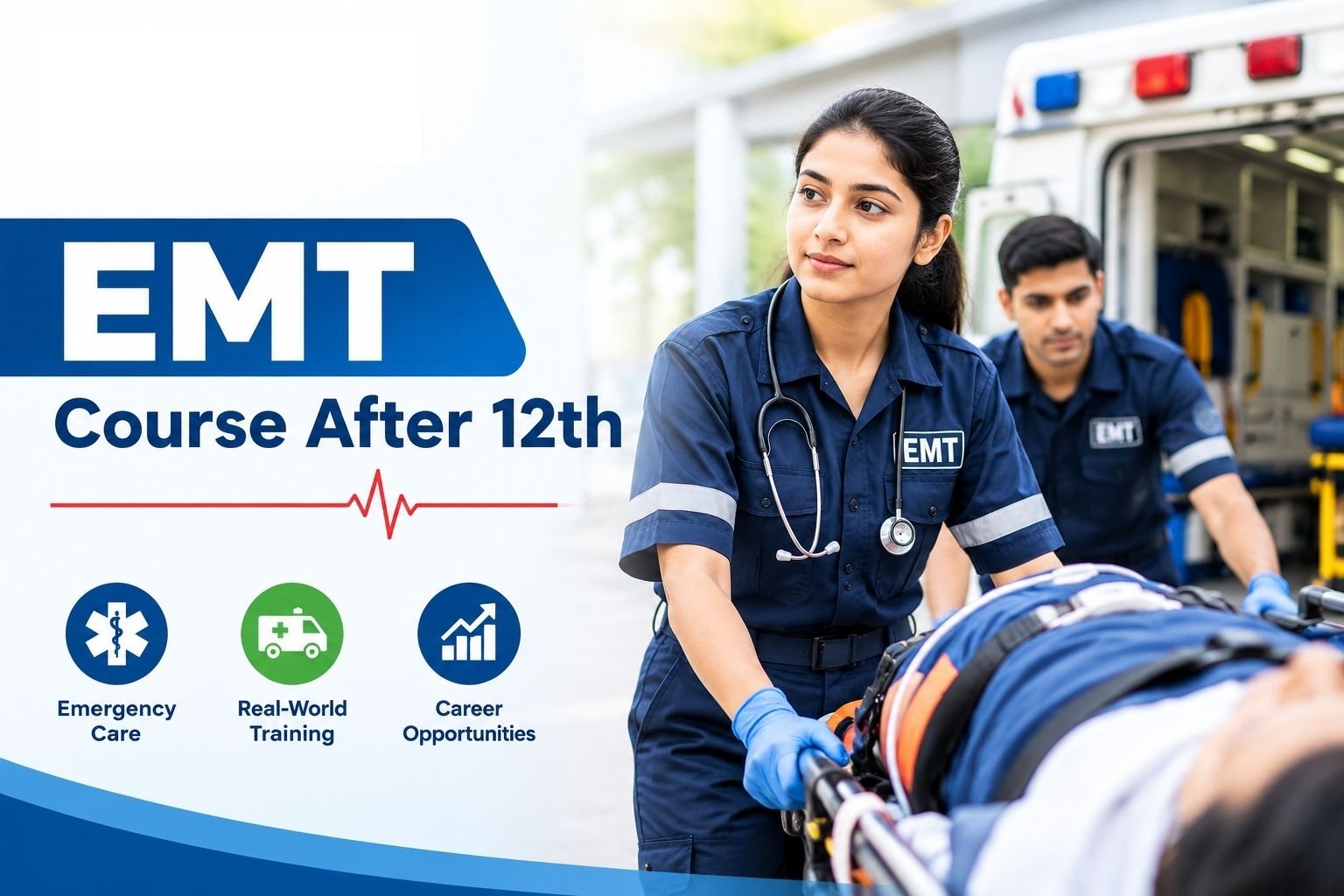
An Emergency Medical Technician (EMT) is a trained healthcare professional who provides emergency medical support to patients who are injured or critically ill. EMTs can be involved in responding to emergency calls, assessing patients at the scene, providing basic emergency care, assisting with patient transfer and transporting patients to an appropriate medical facility.
In India, the Healthcare Sector Skill Council (HSSC) lists Emergency Medical Technician-Basic as a recognized healthcare job role. The current HSSC qualification information lists Emergency Medical Technician-Basic (HSS/Q2301) at NSQF Level 4, with 450 notional hours, including classroom/skill training and on-the-job training.
For students interested in healthcare but looking for a career-oriented course after Class 12, an EMT course can provide an introduction to emergency care, patient handling, ambulance operations, basic clinical skills and emergency response procedures.
What Does an Emergency Medical Technician Do?
An EMT’s work can begin even before a patient reaches the hospital.
Depending on their role, training and scope of practice, an EMT may be involved in:
- Responding to emergency calls
- Assessing the emergency scene
- Checking the patient’s condition
- Providing basic emergency medical support
- Supporting patients during transportation
- Preparing and checking emergency equipment
- Following infection-control and safety procedures
- Assisting with patient movement and transfer
- Communicating relevant information to healthcare professionals
- Supporting emergency and trauma-care teams
The HSSC EMT-Basic curriculum includes areas such as responding to emergency calls, scene safety, patient assessment, patient triage, cardiovascular emergencies, cerebrovascular emergencies, allergic reactions, poisoning and environmental emergencies.
Why Is EMT Training Important?
Emergency situations often require quick decision-making and appropriate first response. Properly trained emergency medical personnel can provide important support while a patient is being transported or waiting for further medical care.
An EMT therefore needs more than theoretical knowledge. Training should also develop practical skills, communication, patient-safety awareness and the ability to work effectively in stressful situations.
EMT Course After 12th
Students who have completed Class 12 can explore EMT training as a healthcare career pathway.
The HSSC model curriculum for Emergency Medical Technician-Basic lists 12th Grade Pass as a prerequisite, along with certain alternative educational pathways.
An EMT course generally combines classroom learning with practical skill development. Depending on the institute and course structure, students may learn about:
- Emergency medical care
- Basic patient assessment
- First aid
- Trauma and accident management
- Ambulance and emergency equipment
- Patient transportation
- Infection control
- Basic life-support concepts
- Communication and professional behaviour
- Emergency response procedures
The HSSC model curriculum specifically emphasizes emergency response, scene safety, infection control, patient transfer and communication skills.
EMT Course Eligibility in India
One of the most common questions students ask is: “What is the eligibility for an EMT course after 12th?”
For the HSSC Emergency Medical Technician-Basic qualification, the model curriculum identifies 12th Grade Pass as one of the entry requirements. The HSSC job-role overview also identifies Class XII as the educational qualification for the EMT-Basic role.
However, eligibility can vary between institutes and individual programs. Students should always check the admission requirements of the specific training institute before applying.
Basic Eligibility
A student looking for an EMT course may generally need:
- Class 12 qualification
- Interest in healthcare and emergency services
- Ability to communicate effectively
- Willingness to participate in practical training
- Ability to work in a team
- A responsible and patient-focused attitude
Some programs may have additional requirements relating to age, medical fitness, documentation or admission procedures.
What Do You Learn in an EMT Course?
A good EMT training program should balance theory, practical skills and workplace exposure.
The HSSC EMT-Basic model curriculum covers competencies related to emergency medical care, emergency calls, scene safety, patient assessment, trauma emergencies, infection control, ambulance preparation and patient transfer.
1. Emergency Medical Care
Students learn the fundamentals of emergency medical services and understand the role of an EMT within the healthcare system.
2. Patient Assessment
Students learn how to assess a patient’s condition and identify situations requiring urgent medical attention.
3. Trauma and Accident Care
Training can cover emergency situations involving injuries and trauma, including appropriate patient handling and transportation.
4. Ambulance and Emergency Equipment
Students can become familiar with the equipment and environment used during emergency transportation.
5. Infection Control
Safe practices are an important part of emergency healthcare. Students learn appropriate infection-control procedures and personal protection measures.
6. Patient Transfer and Transportation
EMTs may need to assist with moving and transporting patients safely. The HSSC curriculum includes safe and efficient transferring and ambulation techniques.
7. Communication Skills
An EMT needs to communicate accurately with patients, relatives, emergency teams and other healthcare professionals.
EMT Course Duration
The duration of an EMT course depends on the specific program and institute.
For reference, the HSSC’s current Emergency Medical Technician-Basic qualification lists 450 notional hours, including 100 hours of theory, 140 hours of practical training, 60 hours of employability skills and 150 hours of on-the-job training.
Students should therefore check the exact duration, curriculum, practical training and clinical/field exposure offered by their chosen institute rather than assuming every EMT course has the same duration.
Skills You Need to Become an EMT
An EMT career can be demanding because emergency situations may require calm and responsible action.
Important skills include:
Quick Decision-Making
Emergency situations can change rapidly, so EMTs need to assess situations and respond appropriately.
Communication
Clear communication is important when interacting with patients, families and healthcare teams.
Teamwork
EMTs often work alongside other emergency and healthcare professionals.
Patient Care
A patient-focused approach helps create a safer and more supportive experience during emergencies.
Physical and Emotional Readiness
Emergency healthcare can involve physically demanding situations and stressful circumstances. Professional training helps students understand how to work safely and responsibly.
Attention to Safety
Scene safety, infection control and appropriate handling of equipment are important parts of EMT training.
Career Opportunities After an EMT Course
After completing suitable EMT training and meeting the requirements of the relevant employer or qualification, students can explore opportunities in different healthcare and emergency-care environments.
Potential work settings can include:
- Hospitals
- Ambulance services
- Emergency medical service providers
- Trauma-care facilities
- Healthcare organizations
- Emergency response services
- Patient transportation services
- Industrial or workplace emergency-response teams
The exact job title, responsibilities and eligibility for employment can vary depending on the employer, qualification and applicable regulations.
The HSSC describes the EMT-Basic role as providing emergency medical support and care to critically ill or injured individuals and transporting them to a medical facility within stipulated time limits.
EMT vs Other Healthcare Courses
Students often compare EMT with other healthcare training options.
| Course | Main Focus |
|---|---|
| EMT | Emergency medical care and patient transportation |
| GDA | Patient care and hospital support |
| OT Technician | Operation theatre assistance and support |
| Nursing | Comprehensive nursing education and patient care |
| Medical Laboratory Technician | Laboratory testing and diagnostic support |
Choosing the right course depends on your interests and career goals.
If you enjoy emergency situations, patient support, ambulance services and fast-paced healthcare environments, EMT training may be worth considering.
Is EMT a Good Career Option After 12th?
For students interested in healthcare and emergency services, EMT training can be a practical career-oriented option.
It can be particularly suitable for students who:
- Want to enter the healthcare sector after 12th
- Are interested in emergency care
- Want practical, skill-based training
- Enjoy helping patients
- Can work effectively under pressure
- Want to explore ambulance and emergency medical services
However, students should carefully compare the course curriculum, practical training, certification, placement support, faculty and training facilities before enrolling.
Why Choose an EMT Course in Mohali?
Students looking for an EMT course in Mohali can consider training institutes that provide a combination of classroom education and practical skill development.
When comparing EMT institutes in Mohali, look for:
- Experienced trainers
- Practical skill sessions
- Emergency-care equipment
- Hands-on learning
- Clinical or workplace exposure where applicable
- Proper assessment
- Course certification details
- Career guidance
- Convenient location and training schedule
The quality of practical training is particularly important because EMT work involves applying knowledge in real-world emergency situations.
How to Choose the Right EMT Course After 12th
Before taking admission, ask the institute these questions:
1. What is the course curriculum?
Check whether the program covers emergency response, patient assessment, trauma care, infection control and practical skills.
2. How much practical training is included?
A healthcare course should not rely only on classroom theory.
3. Is there on-the-job or clinical exposure?
Ask what type of practical or workplace training is included.
4. What certification is provided?
Understand the name of the certification and the organization responsible for assessment or certification.
5. What are the admission requirements?
Confirm eligibility, age requirements and required documents before applying.
6. What career support is available?
Ask about career guidance, interview preparation and placement assistance, if offered.
Frequently Asked Questions About EMT Course After 12th
What is an EMT?
An EMT, or Emergency Medical Technician, is a trained healthcare worker who provides emergency medical support to critically ill or injured patients and assists with their transportation to medical facilities.
Can I do an EMT course after 12th?
Yes. The HSSC EMT-Basic model curriculum lists 12th Grade Pass as an entry requirement for the qualification. Individual institutes may have additional admission requirements.
What is the eligibility for an EMT course in India?
For the HSSC EMT-Basic qualification, Class 12 is listed as an educational prerequisite. Students should verify the eligibility requirements of the particular institute and course they intend to join.
What subjects are taught in an EMT course?
Topics can include emergency medical care, patient assessment, trauma emergencies, infection control, patient transfer, ambulance operations, emergency equipment and communication skills.
How long is an EMT course?
Course duration varies by program. The HSSC EMT-Basic qualification currently specifies 450 notional hours, including theory, practical, employability skills and on-the-job training.
Where can an EMT work?
Depending on qualification and employer requirements, EMTs may work in hospitals, ambulance services, emergency-care organizations, trauma facilities and other healthcare settings.
Is practical training important for EMT students?
Yes. EMT work is skill-oriented, so practical learning is an important part of training. The HSSC curriculum includes practical competencies related to emergency response, patient assessment, infection control and patient transfer.
Can I study EMT in Mohali?
Yes. Students can explore EMT training institutes in Mohali and compare their curriculum, practical facilities, eligibility, certification and career-support options before admission.
Start Your Healthcare Career with EMT Training
An EMT course after 12th can introduce students to emergency medical care and provide a pathway into the healthcare sector. From patient assessment and emergency response to ambulance support and patient transportation, EMT training focuses on practical skills that are relevant to emergency-care environments.
If you are planning to join an EMT course in Mohali, compare institutes carefully and choose a program that provides appropriate theoretical education, practical training and career guidance.
Interested in starting your healthcare career?
Explore EMT Training at SPAW Academy
SPAW Academy
Sector 70, Mohali
Phone: 7837749294
Enroll Now and Start Your Healthcare Career.