EMT Course in Mohali – Emergency Medical Technology
Duration: 6 Moths
Eligibility: 12th
Training: Classroom + Practical Training
Location: Sector 70, Mohali
Affiliation: SDC Canada / GSDM-NSDC pathway, as applicable
Start a rewarding career in childcare with the Nanny / Child Caregiver Course at SPAW Academy. This course provides practical training in infant care, child safety, nutrition, and early childhood development.
Build Caregiving Skills. Build a Meaningful Healthcare Career.
Build Skills for Emergency Medical Care
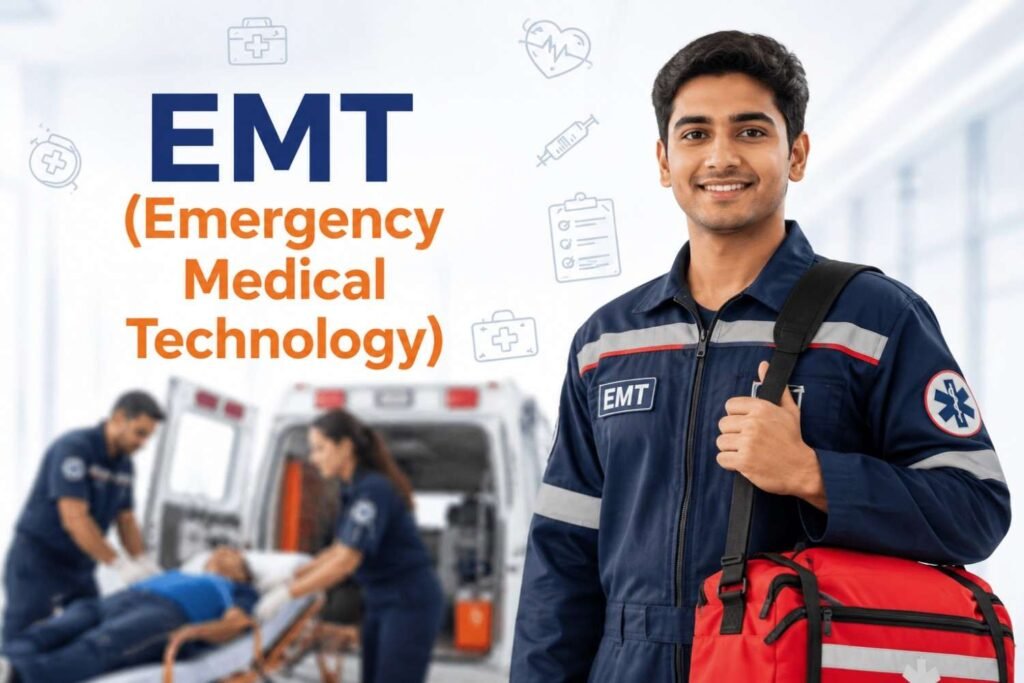
The EMT – Emergency Medical Technology Course at SPAW Academy, Mohali is designed for individuals who want to build practical skills in emergency response, patient care, first aid, basic life support and emergency medical services.
Emergency Medical Technicians play an important role in responding to medical emergencies, supporting patients and assisting with safe patient movement and emergency-care procedures within their defined scope of practice.
At SPAW Academy, students can develop healthcare skills through a combination of classroom learning, practical training and emergency-care skill development in a professional healthcare environment.
The official NSDC listing identifies Emergency Medical Technician – Basic (HSS/Q2301) under the Healthcare Sector Skill Council’s Allied Health and Paramedics category and lists it at NSQF Level 4.
Course Overview
1. What Is an EMT Course?
EMT stands for Emergency Medical Technician.
An EMT is a trained healthcare support professional who assists with emergency medical care and patient support before and during transportation to an appropriate healthcare facility, according to their training, role and applicable protocols.
The EMT training pathway focuses on developing the ability to respond appropriately to emergency situations, maintain scene safety, provide basic emergency care, support patients and communicate effectively with healthcare and emergency-response teams.
The NSDC/Healthcare Sector Skill Council EMT-Basic curriculum includes competencies related to emergency medical services, scene safety, emergency response, patient transfer, infection control, emergency situations and professional communication.
Key Areas of EMT Training
- Emergency response
- Basic first aid
- Patient assessment
- Basic life support awareness
- CPR training
- Airway and breathing support concepts
- Bleeding and injury management
- Trauma-care basics
- Patient transportation
- Safe patient transfer
- Infection prevention
- Emergency communication
- Ambulance and emergency equipment awareness
- Professional behaviour
Why Choose an EMT Career?
Emergency situations require trained professionals who can remain calm, respond quickly and provide appropriate support while following established emergency-care procedures.
An EMT course can provide a foundation for individuals interested in emergency medical services and healthcare-support careers.
Who Is This Course For?
The EMT course can be suitable for individuals who:
- Are interested in emergency healthcare
- Want to work in emergency medical services
- Have an interest in first aid and patient care
- Want practical healthcare training
- Can remain calm in challenging situations
- Are comfortable working in a team
- Want to develop emergency-response skills
- Are interested in ambulance and emergency-care environments
- Want to build a career in allied healthcare and emergency services
This Course May Be Suitable For
Healthcare Career Aspirants
Students who want to enter the healthcare sector through an emergency-care focused skill pathway.
Emergency Care Enthusiasts
Individuals interested in emergency response, first aid and patient support.
Healthcare Support Workers
People who want to strengthen their knowledge of emergency-care practices.
Students Looking for Practical Training
Candidates who prefer hands-on healthcare learning rather than theory-only education.
Eligibility
Who Can Apply for the EMT Course?
The exact eligibility for SPAW Academy’s EMT programme depends on the selected course and affiliation pathway.
For the Emergency Medical Technician-Basic qualification, the Healthcare Sector Skill Council model curriculum lists 12th Grade Pass as a standard entry requirement, with alternative pathways for certain diploma/undergraduate candidates and relevant prior qualifications/experience.
Course Duration
EMT Course Duration
Course: Emergency Medical Technology / EMT
Duration: 600 Hours
Training Mode: Classroom + Practical Training
Location: SPAW Academy, Sector 70, Mohali
Affiliation: SDC Canada / GSDM-NSDC, as applicable
The official NSDC model curriculum for EMT-Basic lists a 600-hour training structure, comprising theory hours, practical hours and employability/entrepreneurship hours for the listed qualification. This should not be presented as SPAW Academy’s own duration unless your specific programme follows that exact curriculum.
Course Curriculum
The EMT curriculum is designed to develop foundational knowledge and practical skills required for emergency medical support.
Module 1: Introduction to Emergency Medical Services
Students learn about:
- Emergency Medical Services
- Role of an EMT
- Emergency-care systems
- Responsibilities of emergency medical personnel
- Professional conduct
- Patient and crew safety
Module 2: Scene Safety and Emergency Response
Training includes understanding:
- Assessing scene safety
- Personal safety
- Patient safety
- Bystander safety
- Personal protective equipment
- Emergency-response procedures
- Communication with emergency teams
Module 3: Basic Anatomy and Physiology
Students develop an understanding of:
- Major body systems
- Normal body functions
- Basic signs and symptoms
- Relationship between body systems and emergency conditions
Module 4: Patient Assessment
Students learn the fundamentals of:
- Initial patient assessment
- Identifying immediate concerns
- Monitoring patient condition
- Gathering relevant information
- Communicating findings appropriately
Module 5: First Aid and Basic Emergency Care
Topics may include:
- First aid principles
- Management of common emergencies
- Injury support
- Bleeding control
- Shock awareness
- Basic emergency response
Module 6: CPR and Basic Life Support
Students develop awareness and practical skills related to:
- Cardiopulmonary resuscitation
- Basic life support
- Recognising cardiac emergencies
- Emergency response sequence
- Use of training equipment/manikins
The exact CPR/BLS training and certification should be described according to the specific course offered by SPAW Academy.
Module 7: Airway and Breathing Emergencies
Students learn basic concepts related to:
- Airway assessment
- Breathing difficulties
- Emergency airway support
- Oxygen therapy awareness
- Respiratory emergencies
Module 8: Trauma and Injury Management
Training may cover:
- Fracture and injury awareness
- Bleeding management
- Soft-tissue injuries
- Spinal injury awareness
- Trauma assessment
- Safe movement and transportation
Module 9: Patient Movement and Transportation
Students learn:
- Safe patient handling
- Patient transfer
- Ambulation support
- Use of appropriate transportation equipment
- Safe movement during emergencies
Module 10: Medical Emergencies
Students develop awareness of emergency situations such as:
- Breathing emergencies
- Cardiac emergencies
- Altered consciousness
- Seizures
- Diabetic emergencies
- Allergic reactions
- Poisoning
- Other urgent medical conditions
Module 11: Paediatric and Special Emergencies
Depending on the applicable curriculum, students may learn emergency-care considerations for:
- Children
- Elderly patients
- Pregnant patients
- Patients with special needs
Module 12: Infection Prevention and Control
Students learn:
- Hand hygiene
- PPE use
- Infection-prevention practices
- Blood and body-fluid precautions
- Safe handling of contaminated materials
- Healthcare workplace safety
Module 13: Ambulance and Emergency Equipment
Training may introduce students to:
- Ambulance environment
- Emergency kits
- Patient transportation equipment
- Basic emergency equipment
- Equipment safety and readiness
Module 14: Communication and Professional Skills
Students develop:
- Patient communication
- Emergency communication
- Team coordination
- Professional behaviour
- Documentation awareness
- Communication with family members
- Stress management and workplace conduct
The official EMT-Basic curriculum covers emergency medical services, scene safety, personal protection, emergency scenarios, patient transfer, infection control, ambulance setup and professional communication.
Practical Training
Learn Emergency Skills Through Practical Training
Emergency medical care is highly practical. EMT professionals need confidence in responding to emergency situations and must be able to perform appropriate actions according to their training and scope.
At SPAW Academy, practical training can help students develop hands-on understanding of emergency-care concepts.
Practical Training May Include
- Emergency-response scenarios
- CPR practice
- Basic life-support practice
- Patient assessment exercises
- First-aid practice
- Bleeding-control techniques
- Patient transfer
- Safe patient movement
- Trauma-care simulations
- Infection-control practices
- PPE usage
- Emergency equipment familiarisation
- Ambulance environment orientation
- Emergency communication exercises
Hospital-Based Learning Environment
SPAW Academy is located at SPAW Hospital, Sector 70, Mohali, giving students access to a healthcare-focused learning environment.
Students can gain exposure to professional healthcare workflows, teamwork, patient interaction and workplace discipline.
Skills You Will Learn
By completing EMT training, students can develop skills in:
Emergency Response
Understand how emergency situations are assessed and how appropriate response procedures are initiated.
Patient Assessment
Develop basic skills for assessing patients and recognising situations that require urgent medical attention.
First Aid
Learn foundational first-aid techniques for common emergency situations.
CPR & Basic Life Support
Develop practical awareness and skills related to CPR and basic life-support procedures according to the applicable training curriculum.
Trauma Support
Understand basic emergency support for injuries, bleeding and trauma situations.
Patient Transportation
Learn safe approaches to moving, transferring and transporting patients.
Infection Control
Understand PPE, hand hygiene and infection-prevention practices.
Emergency Equipment
Become familiar with relevant emergency-care equipment and its safe use within the training scope.
Communication
Learn to communicate clearly with patients, relatives, emergency teams and healthcare professionals.
Teamwork
Develop the ability to work effectively as part of an emergency-care team.
Professional Behaviour
Build discipline, responsibility, emotional control and workplace professionalism.
Career Opportunities
After completing EMT training, candidates may explore healthcare and emergency-service opportunities depending on their qualification, certification, skills and employer requirements.
Potential Career Roles
- Emergency Medical Technician
- EMT-Basic
- Emergency Care Support Staff
- Ambulance Support Staff
- Emergency Healthcare Assistant
- Patient Transport Support
- Emergency Medical Services Support
Potential Career Areas
Ambulance Services
Support emergency response and patient transportation according to the assigned role.
Hospitals
Work in emergency-care and patient-support environments where the qualification and employer requirements permit.
Emergency Medical Services
Support emergency response teams and patient-care operations.
Healthcare Facilities
Provide emergency-care support within the defined scope of the role.
Patient Transportation Services
Assist with safe patient movement and transportation.
Work Environments
An EMT may work in healthcare and emergency-service environments such as:
Ambulance Services
Emergency response and patient transportation environments.
Hospitals
Emergency departments and other areas where EMT-qualified personnel are employed.
Emergency Medical Services
Emergency-response operations and support teams.
Healthcare Facilities
Healthcare environments requiring trained emergency-care support.
Patient Transportation Services
Services involved in safe movement and transportation of patients.
Disaster and Emergency Response
Depending on qualifications, training and organisational requirements, EMT professionals may support emergency-response activities.
Certification / Affiliation
EMT Course – Certification Pathways
SPAW Academy offers EMT training through its available affiliation pathways.
Medhavi University
Course: EMT – Emergency Medical Technology
Affiliation: Medhavi Skills University
Training Institute: SPAW Academy
Location: Sector 70, Mohali
Training: Classroom + Practical Training
Certification: As applicable to the specific Medhavi Skills University
Why Study EMT at SPAW Academy?
Hospital-Based Healthcare Learning
Learn in a professional healthcare environment at SPAW Academy, located at SPAW Hospital, Sector 70, Mohali.
Practical Emergency Training
Develop hands-on understanding through emergency-care exercises, simulations and practical sessions.
Healthcare-Experienced Trainers
Learn from trainers with relevant healthcare and practical knowledge.
Emergency-Care Focus
Build skills around emergency response, patient care, first aid, safety and communication.
Career-Focused Curriculum
Develop skills designed to prepare learners for potential healthcare and emergency-service opportunities.
EMT Pathways
Explore EMT training options through the applicable Medhavi (GSDM/NSDC) pathways.
Professional Skill Development
Develop teamwork, communication, discipline and workplace-readiness skills alongside technical learning.
Convenient Mohali Location
SPAW Academy, SPAW Hospital, Sector 70, Mohali
Fees
EMT Course Fees
The EMT course fee may vary depending on:
- Selected affiliation pathway
- Course duration
- Batch
- Curriculum
- Practical training
- Assessment
- Certification-related components
Get the Latest EMT Fee Details
For the current fee structure, contact SPAW Academy’s admission team.
Call: 7837749294
Fee May Include
Depending on the selected course:
- Classroom training
- Practical training
- Learning resources
- Assessment
- Certification-related components
The exact fee inclusions should be confirmed with the admission counsellor before enrolment.
FAQ's
What is an EMT course?
EMT stands for Emergency Medical Technician. An EMT course provides training in emergency response, basic emergency care, patient support, safety, patient movement and communication within the defined scope of the role.
What does an Emergency Medical Technician do?
An EMT may respond to emergencies, assess and support patients, provide basic emergency care, assist with patient movement and transportation, and communicate with emergency and healthcare teams according to their training and scope of practice.
What is the EMT-Basic qualification?
Emergency Medical Technician-Basic is a recognised healthcare occupational qualification listed by NSDC under the Healthcare Sector Skill Council. The NSDC listing identifies it as HSS/Q2301 and NSQF Level 4.
What is the eligibility for an EMT course?
Eligibility depends on the specific programme. The Healthcare Sector Skill Council’s EMT-Basic model curriculum lists 12th Grade Pass as a standard entry route, along with certain alternative educational pathways. SPAW Academy’s exact eligibility should be confirmed before admission.
Can I join an EMT course after 10th?
Eligibility varies by course and affiliation. The standard EMT-Basic curriculum referenced by HSSC lists 12th Grade Pass as a prerequisite, so students should not assume that every EMT programme accepts 10th-pass candidates. Confirm the exact SPAW Academy programme eligibility before applying.
Is practical training included in the EMT course?
Yes. Practical learning is an important component of EMT training. The official NSDC-listed EMT-Basic programme includes substantial practical training.
Will I learn CPR in an EMT course?
CPR and basic life-support skills are commonly included in EMT-Basic training. The exact CPR curriculum and certification offered by SPAW Academy should be confirmed for the selected programme.
Will I learn first aid?
Yes. Emergency first-aid principles and emergency-response skills are important components of EMT training.
Is EMT a nursing course?
No. EMT and nursing are different healthcare career pathways. EMT training focuses on emergency medical response and patient support, while nursing is a separate professional education and registration pathway.
Can an EMT give injections or medicines?
EMTs must work within their authorised scope of practice, training and applicable protocols. Students should not assume that every clinical procedure or medication administration is permitted solely because they have completed an EMT course.
Where can an EMT work?
Depending on qualification and employer requirements, EMT-trained candidates may explore opportunities in ambulance services, hospitals, emergency medical services, patient transportation and other emergency-care environments.
Is EMT a good career option?
EMT can be a suitable career pathway for individuals interested in emergency healthcare, patient care and fast-paced medical environments. Career opportunities depend on qualification, skills, certification, employer requirements and location.
Does SPAW Academy provide hospital-based training?
SPAW Academy is located at SPAW Hospital, Sector 70, Mohali, and its training approach includes healthcare-focused practical learning. The exact nature and extent of hospital exposure should be confirmed for the specific EMT batch.
Does SPAW Academy offer EMT under SDC Canada?
SPAW Academy lists EMT under its SDC Canada affiliated course pathway. Students should verify the exact course-level affiliation and certification details before admission.
Does SPAW Academy offer EMT under GSDM / NSDC?
Yes, SPAW Academy lists EMT under its GSDM / NSDC affiliated course pathway. Students should confirm the exact programme and certification details applicable to the current batch.
Which EMT pathway should I choose?
The right pathway depends on your education, career objectives, course structure, certification pathway and eligibility. Our admission counsellor can explain the available options before you enrol.
What is the EMT course fee?
The fee depends on the selected pathway, duration, batch and certification/assessment structure. Contact SPAW Academy for the latest fee details.
Where is SPAW Academy located?
SPAW Academy is located at:
SPAW Hospital, Sector 70, Mohali, Punjab – 160071
How can I apply for the EMT course?
You can submit the enquiry form on this page or contact SPAW Academy directly.
Call: 7837749294
Emergency healthcare requires knowledge, practical skills, teamwork, discipline and the ability to respond responsibly under pressure.
The EMT course at SPAW Academy is designed to help students build foundational emergency-care skills through classroom learning and practical training in a healthcare-focused environment.
GET COURSE & ADMISSION DETAILS
Call SPAW Academy: 7837749294
WhatsApp SPAW Academy: 8360228569
Location: SPAW Hospital, Sector 70, Mohali